
Odoo for Construction: Managing Project Costing & BOQ
On a construction project, profit rarely leaks all at once — it leaks line by line: a variation no one costed, materials bought twice, a subcontractor certificate paid before the work was measured. By the time the numbers are reconciled at month-end, the margin is already gone.
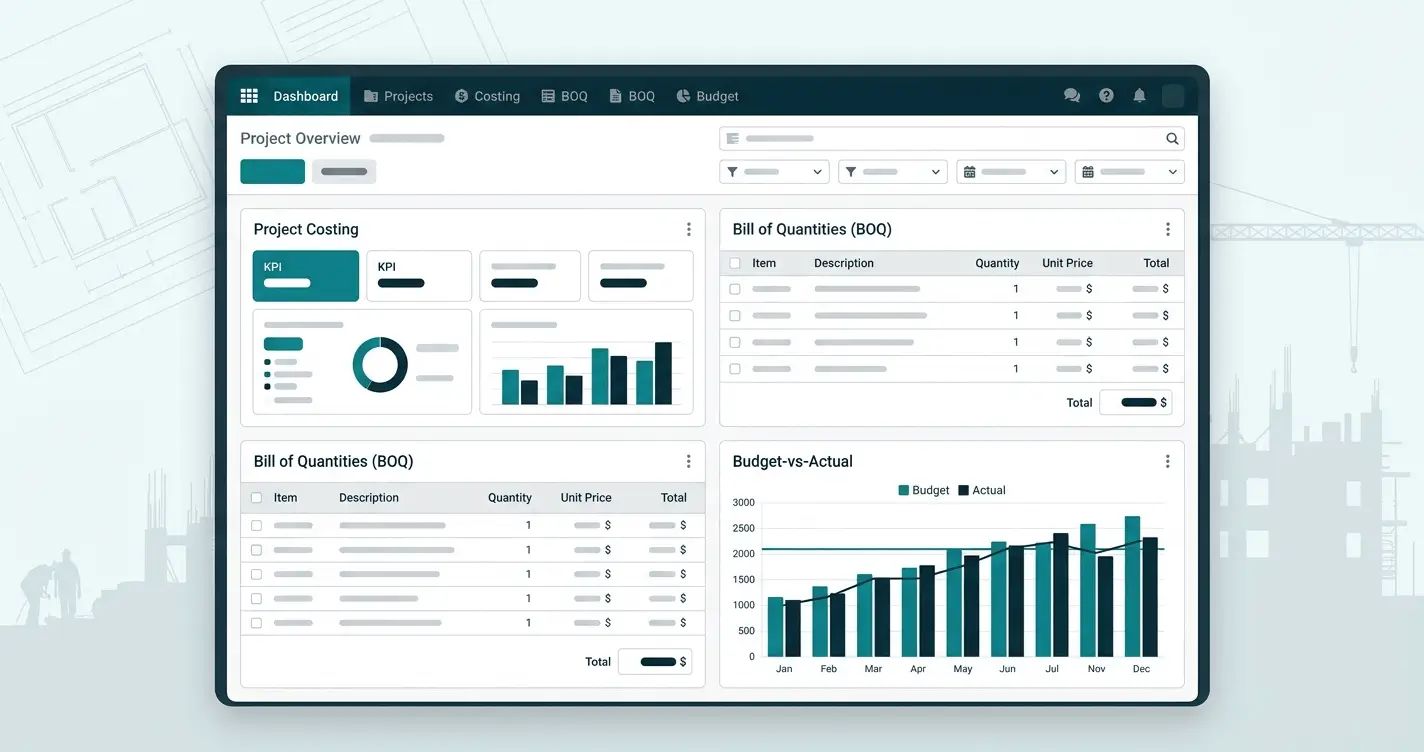
Odoo construction brings project costing and BOQ management into one connected flow — so the budget, the purchase orders, the subcontractor certificates, and the progress billing all roll up to the same project, in real time. This guide explains how project costing and BOQ actually work in Odoo, what's native versus configured, and which setup fits your firm.
Why Construction Project Costing Breaks in Spreadsheets
Spreadsheet costing fails because the budget, the actual spend, and the billing live in separate files — so cost overruns only surface after the money is spent, not while they can still be controlled.
The leaks are predictable:
- Variations added on site but never costed back to the budget.
- Materials ordered without checking committed budget, so commitments stay invisible until the invoice lands.
- Subcontractor certificates paid ahead of measured progress.
- No single budget-vs-actual view per project, so overruns arrive as a surprise.
The fix isn't a bigger spreadsheet — it's a system where every cost is tagged to the project as it happens.
Does Odoo Have a Construction Module?
Odoo doesn't ship a dedicated “Construction” or “BOQ” app. Construction cost control runs on Odoo's Project and Analytic Accounting, with Purchase, Inventory, Timesheets, and Sales — and BOQ and certificate structures added by configuration.
A construction setup on Odoo is built from:
- Project — tasks, phases, and documents tied to one project reference.
- Analytic Accounting — the costing backbone: every cost and revenue tagged to the project (more below).
- Purchase & Inventory — material requests, supplier comparison, POs, and receipts.
- Timesheets — labour cost booked against the project.
- Sales — progress-based customer billing.
One honest point: BOQ structures, cost codes, and certificate rules usually need configuration or a scoped extension — Odoo is the foundation, not a finished BOQ product. For most contractors that's the right trade: a connected core, tailored to how you measure and bill.
How Project Costing Actually Works in Odoo (Analytic Accounting)
Every cost and revenue on a project is tagged to its analytic account — so Odoo shows budget vs. actual per project in real time, not at month-end.
In practice:
- A material PO, a timesheet, and a subcontractor bill are each tagged to the project's analytic account.
- Odoo rolls them up against the project's budget, so committed and actual costs are visible as they happen.
- Variations and extra costs are booked to the same project, so the margin updates instead of drifting.
That's the difference between knowing your cost position today and discovering it after the project closes.
How BOQ and Progress Billing Work in Odoo
A BOQ in Odoo is set up as the project's budget and billing structure — items, quantities, and rates — and customer invoices are raised from measured, approved progress against it.
- BOQ lines map to budget categories, so planned vs. actual is tracked per item.
- Subcontractor work orders carry measured progress, deductions/retention, and certificates.
- Progress billing draws from approved progress, not guesswork — and the same figures flow straight to Accounting.
Because BOQ formats and certificate rules differ by firm, this layer is configured to yours rather than assumed.
Standalone BOQ/Costing Tool vs. Connected Odoo Construction
A standalone BOQ or costing tool estimates in isolation; Odoo connects the estimate to the actual spend — so procurement, subcontractors, and billing update the same budget instead of a separate file.
| Standalone BOQ/costing tool | Odoo construction (connected) | |
|---|---|---|
| BOQ & budget | Yes (estimate only) | Yes, tied to actual costs |
| Procurement | Separate / manual | Material request → PO → receipt |
| Subcontractors | Tracked apart | Work orders, certificates, deductions |
| Cost vs. budget | Re-keyed from other tools | Live per project (analytic) |
| Progress billing | Separate invoicing | From approved progress, into Accounting |
| Multi-project view | Varies | Budget-vs-actual across all sites |
That's what a connected Odoo construction solution is built for — the estimate and the actual in one place.
Which Odoo Construction Setup Fits Your Firm?
Costs scale with complexity — our guide on what an Odoo implementation costs breaks down the drivers. The right setup depends on how you build:
- General contractor with subcontractors — prioritise subcontractor work orders, certificates, and retention.
- Developer building to sell — map sales and progress billing to the project budget.
- Firm bidding on tenders — a configured BOQ structure keeps tender, budget, and actual consistent.
- Multiple concurrent sites — analytic accounting gives one budget-vs-actual view across all projects.
- Operating across Egypt, KSA, or the UAE — one system keeps costing, procurement, and e-invoicing aligned, with Odoo Accounting underneath.
Frequently asked questions
Does Odoo have a construction module?
No single dedicated app. Construction runs on Odoo's Project and Analytic Accounting with Purchase, Inventory, Timesheets, and Sales; BOQ and certificate structures are added by configuration.
How does Odoo handle project costing?
Every cost and revenue is tagged to the project's analytic account, so Odoo shows budget vs. actual per project in real time.
Can Odoo manage a BOQ (bill of quantities)?
Yes, configured as the project's budget and billing structure (items, quantities, rates); the exact BOQ and certificate format is tailored to your firm.
What is analytic accounting in Odoo?
It's how Odoo allocates costs and revenues to a project or cost centre, giving per-project budget-vs-actual reporting — the backbone of construction job costing.
Does Odoo support subcontractor certificates and progress billing?
Yes. Subcontractor work orders carry measured progress, deductions, and certificates, and customer billing is raised from approved progress.
How much does an Odoo construction setup cost?
It depends on your BOQ complexity, number of sites, integrations, and how much is configured versus standard. Contact a certified Odoo partner for a scoped quote.
Heading into 2026, the contractors who protect their margins aren't the ones with the thickest spreadsheets — they're the ones who see cost against budget while the project is still running. Odoo construction connects the BOQ, the procurement, the subcontractors, and the billing to one project, so the margin is managed, not discovered. It's the sector E-TripleSoft delivers most, across Egypt and Saudi Arabia.