
How to Run a Digital Marketing Agency on One System — with Odoo
A typical digital marketing agency runs on ten open tabs: a project tool for tasks, a spreadsheet for time, another for retainers, an accounting app for invoices, and a gut feeling for whether each client is actually making money. Each tool works on its own — but none of them talk to each other, and the numbers never quite line up.
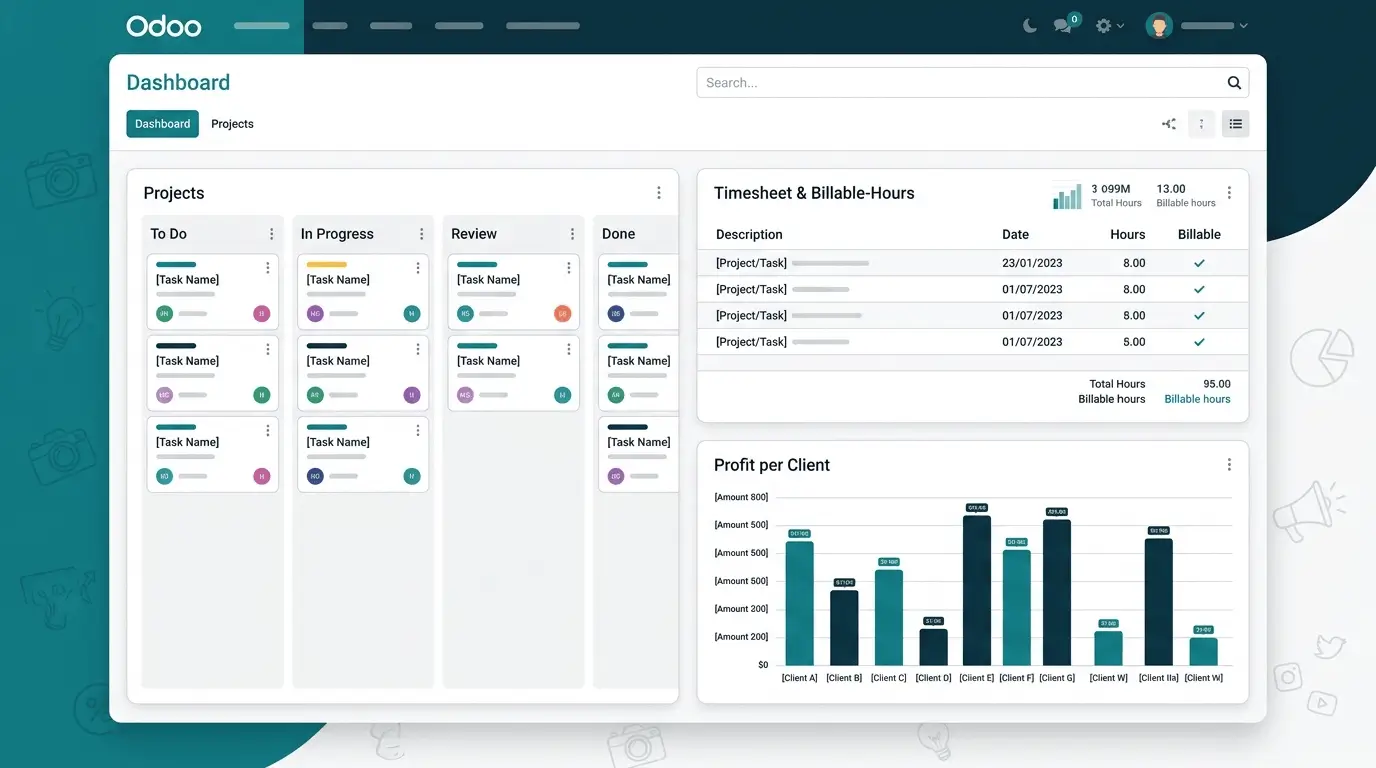
The result is familiar: hours that never get billed, retainers that quietly go over budget, and a profit-per-client figure nobody can produce on demand. This guide shows how a digital marketing agency can run projects, time, clients, and billing on one system with Odoo — and finally see which clients are worth the work.
Why Scattered Tools Cost Agencies Money
When your projects, time, and invoices live in separate tools, the gaps between them are where the money leaks:
- Billable hours get logged late, rounded down, or missed entirely — so you bill less than you worked.
- Retainers drift over scope because no one's comparing hours used against hours sold in real time.
- Invoicing lags behind delivery, stretching cash flow.
- And the big one: you can't see profit per client, because the cost (time) and the revenue (invoices) sit in different places.
None of this is a people problem — it's a system problem, and it's exactly what connecting the tools fixes.
How Odoo Runs the Whole Agency
Odoo isn't agency-specific software — it's a connected business platform you configure for how an agency works. For a digital marketing agency, the core apps map cleanly to what you do:
- CRM & Sales — track leads and proposals, and turn a won deal into a project and a retainer.
- Project — every client's work as tasks, stages, and deadlines in one place.
- Timesheets — the team logs time against the project and task, so billable hours are captured where the work happens.
- Invoicing — bill from time worked or on a retainer schedule, without re-keying anything.
- Planning — schedule who works on what, so capacity is visible before you overcommit.
- Accounting — invoices, costs, and local e-invoicing (ETA / ZATCA) on the same ledger.
Because it's one system, a logged hour, the invoice it belongs to, and the client it's for are all connected — which is what makes the next number possible.
The Number Most Agencies Can't See: Profit per Client
Ask an agency owner which clients are profitable, and most can only guess. The reason is structural: revenue lives in the invoicing tool and cost — mostly your team's time — lives somewhere else, so no one multiplies them out per client.
In Odoo, because time is logged against the project and invoices are raised from the same project, the two meet in one place. You can see the hours a client consumed, the cost of those hours, and what you billed — and the difference is your real margin on that client.
- See billable vs. non-billable hours per client, so scope creep is visible.
- Compare a retainer's sold hours against the hours actually used, before it runs over.
- Rank clients by real profitability, not by invoice size.
That's the shift: from billing by feel to managing the agency by the client-level numbers that decide whether you grow — or just get busier.
Scattered Tools vs. Odoo
The difference isn't the features — it's whether the numbers connect:
| Scattered tools | Odoo (one system) | |
|---|---|---|
| Projects & tasks | A separate PM tool | Project, linked to the client & deal |
| Time tracking | Spreadsheet or app | Timesheets on the task, ready to bill |
| Retainers | Tracked by hand | Sold vs. used hours, in view |
| Invoicing | Re-keyed from timesheets | Raised from time or retainer directly |
| Profit per client | A guess | Hours, cost & billing in one place |
| Local billing | A separate tax tool | Invoicing with ETA / ZATCA built in |
That connection is the whole point of running the agency on one platform — and it's what an Odoo setup is built to give a services business.
Which Odoo Setup Fits Your Agency
How much you switch on depends on your size and how you bill:
- Small or boutique agency — CRM, Project, and Timesheets alone connect your pipeline, your work, and your billable time.
- Retainer-heavy agency — add Invoicing and reporting to watch sold vs. used hours per client.
- Multi-service or growing agency — add Planning and Accounting so capacity and finance stay in one view as you scale.
- Billing clients across Egypt, KSA, or the UAE — Odoo keeps invoicing, e-invoicing, and bilingual documents aligned with local rules.
What it costs depends on your team size and the apps you run, so the figure that matters is yours — book a free consultation for pricing matched to your agency, and treat it as part of your wider Odoo implementation plan.
Frequently asked questions
Can Odoo manage a digital marketing agency?
Yes. Odoo isn't agency-specific software, but its CRM, Project, Timesheets, Invoicing, Planning, and Accounting apps cover how an agency runs — pipeline, projects, billable time, retainers, and client billing — in one connected system.
How does Odoo track billable hours for an agency?
Your team logs time in Timesheets against the project and task they're working on. Because that time is linked to the client's project, it can be billed directly or measured against a retainer, so hours don't get missed.
Can Odoo handle agency retainers?
Yes. You can bill a client on a recurring retainer and compare the hours sold against the hours your team actually logs — so you can see when a retainer is going over scope before it costs you.
How do I see profit per client in Odoo?
Because time (your main cost) and invoices (your revenue) live on the same project, Odoo can show the hours a client used, the cost of those hours, and what you billed — giving you real margin per client instead of a guess.
Is Odoo better than a dedicated agency tool?
It depends on your needs. A dedicated tool may do one job well; Odoo's advantage is connecting projects, time, billing, and accounting in one system so the numbers line up. Many agencies value that single source of truth over separate specialized tools.
How much does Odoo cost for an agency?
It depends on your team size and which apps you enable. The most accurate figure comes from talking to an Odoo partner — book a free consultation for pricing matched to your agency.
An agency doesn't grow by adding another tool — it grows by seeing its work and its money in one place. Running projects, time, retainers, and billing on Odoo turns ten disconnected tabs into one system, and turns “which clients are profitable?” from a guess into a number. For agencies across Egypt, Saudi Arabia, and the UAE, that clarity is the difference between being busy and being profitable.