
Odoo for Restaurants: How to Control Food Cost
In a restaurant, the menu price is fixed on the board — but the cost behind each plate moves every day. A supplier raises the price of oil, a cook over-portions, a tray of produce spoils in the walk-in. None of it shows up until the month closes and the margin is already thinner than it should be.
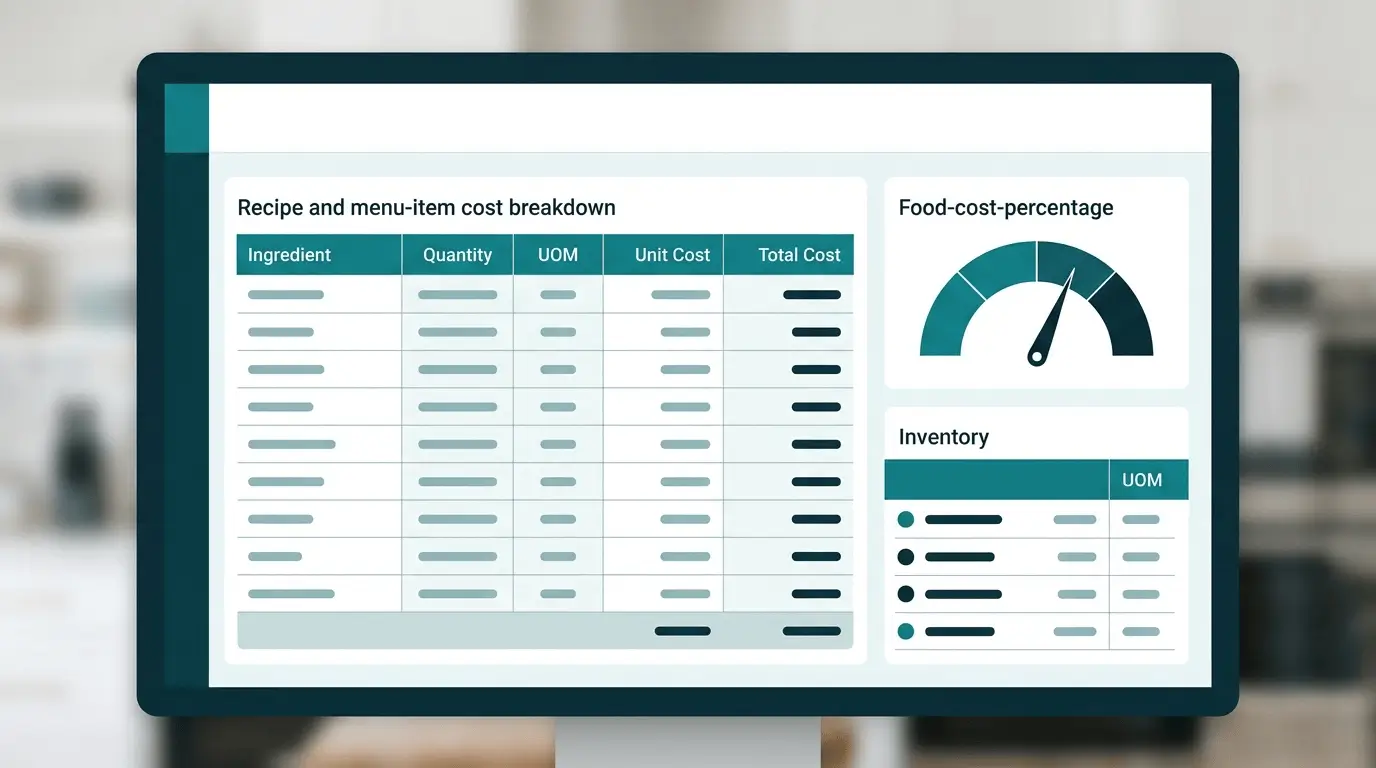
Food cost is the hardest number in a restaurant to keep steady, and it's where most of the profit quietly leaks. Odoo controls it by connecting the recipe, the stock, the POS, and the purchasing into one system — so you can see what a plate should cost versus what it actually cost, while there's still time to act. This guide explains how restaurant food cost control works in Odoo.
Why Restaurant Food Cost Is Hard to Control
Food cost slips because the numbers that drive it live in different places — the recipe in someone's head, the stock on a shelf, the sales in the POS, the prices on supplier invoices. When they're not connected, the gaps stay invisible until it's too late to fix them.
The usual leaks:
- No standard recipe, so portions — and cost per plate — drift from cook to cook.
- Stock isn't tied to sales, so no one knows what should have been used versus what actually was.
- Waste, spoilage, and over-portioning stay invisible until a physical count.
- Supplier prices creep up without anyone re-costing the menu.
The fix isn't counting harder — it's a system where the recipe, the stock, and the sale are the same data.
How Odoo Controls Food Cost
Odoo handles food cost by connecting four things that are usually separate: the recipe (what a dish is made of), the inventory (what's in stock), the POS (what's sold), and purchasing (what ingredients cost). Together they turn food cost from a month-end surprise into a number you watch.
- Recipes — each dish costed from its ingredients (more below).
- Inventory — stock levels that move as dishes are sold.
- Point of Sale — every sale depletes the ingredients behind it.
- Purchase — ingredient costs tracked so the recipe cost stays current.
The result is a live link between a sale on the POS and the stock and cost behind it — the foundation of real food cost control.
Recipe Costing with Bills of Materials
In Odoo, a recipe is set up as a Bill of Materials (BoM) — the same structure manufacturing uses — listing every ingredient and quantity in a dish. Odoo costs the dish from its ingredients, so you know the theoretical cost of every plate and your target food cost percentage before it's ever sold.
- Each menu item has a recipe (BoM) with ingredients and quantities.
- Odoo values the recipe from current ingredient costs, giving a cost per plate.
- When an ingredient price changes, the dish cost updates — so your menu margins stay honest.
That's the baseline: what each plate should cost. The next step is comparing it to what actually happened.
Linking Stock to POS Sales
When a dish sells on the POS, Odoo can deplete the ingredients in its recipe from inventory. That gives you theoretical usage — what the sales say you should have consumed — to compare against a physical count.
- Every sale reduces stock by the recipe's ingredients, not just the finished item.
- Theoretical usage (from sales) vs. actual count reveals the variance — waste, over-portioning, or loss.
- The gap is where food cost leaks, and now it's visible instead of hidden.
That variance is the number most restaurants never see — and the one that explains where the margin went.
Keeping Purchase Prices Under Control
Food cost only stays accurate if ingredient costs do. Odoo's Purchase app tracks what you actually pay suppliers, so the cost flowing into every recipe reflects today's prices, not last quarter's.
- Purchase orders and vendor bills record the real price per ingredient.
- Rising costs show up in the recipe cost, flagging menu items that need re-pricing.
- Buying is tied to stock and sales, so you reorder on real usage, not guesswork.
Manual Tracking vs. Odoo
The difference is whether food cost is something you reconstruct after the fact, or something you watch as it happens.
| Manual / spreadsheet | Odoo (connected) | |
|---|---|---|
| Recipe cost | Worked out by hand, soon outdated | Costed from live ingredient prices |
| Stock vs. sales | Counted, then guessed | Theoretical usage vs. actual count |
| Waste & variance | Found at month-end | Visible per period, per item |
| Purchase prices | Re-keyed from invoices | Flow into recipe cost automatically |
| Menu re-pricing | Reactive | Flagged when cost rises |
| Across branches | Separate files | One view of cost and stock |
Pulling recipe, stock, POS, and purchasing into one place is exactly what a connected Odoo restaurant solution is built to do — food cost control is one outcome of it.
Which Odoo Setup Fits Your Restaurant?
How much you put in place depends on your operation — and the cost drivers are covered in our guide on what an Odoo implementation costs:
- Single location — recipes plus POS-linked inventory already expose most of the food cost leaks.
- Multiple branches — one view compares food cost and variance across locations.
- Central kitchen / commissary — track production and transfers so each branch's cost stays accurate.
- Operating across Egypt, KSA, or the UAE — one system keeps costing, purchasing, and e-invoicing aligned, with Odoo Accounting underneath.
Frequently asked questions
How does Odoo calculate food cost?
Odoo costs each dish from its recipe (a Bill of Materials) using current ingredient prices, giving the theoretical cost per plate. Linked to POS sales and stock, it then compares that to actual usage to show your real food cost.
Can Odoo track restaurant recipes?
Yes. Each menu item is set up as a Bill of Materials listing its ingredients and quantities, so Odoo knows what every dish is made of and what it should cost.
Does Odoo link the POS to inventory?
Yes. When a dish sells on the Odoo POS, the ingredients in its recipe can be depleted from stock — so sales, inventory, and cost stay connected in real time.
What is theoretical vs. actual food cost?
Theoretical cost is what your sales say you should have used (from the recipes); actual is what a physical count shows you really used. The gap is waste, over-portioning, or loss — and it's where margin leaks.
Can Odoo manage food cost across multiple branches?
Yes. Odoo gives one view of recipes, stock, and food cost across locations, and can track a central kitchen's production and transfers so each branch's cost stays accurate.
How much does an Odoo restaurant setup cost?
It depends on the number of branches, which apps you connect (POS, Inventory, Manufacturing, Accounting), and your integrations. Contact a certified Odoo partner for a scoped quote.
Food cost is where restaurant profit is won or lost, and it's too fast-moving to manage from a spreadsheet. By connecting the recipe, the stock, the sale, and the purchase, Odoo turns food cost into a number you can see and act on — before the margin is gone. It's one of the clearest wins for restaurant operators across Egypt and Saudi Arabia.