
Odoo vs Zoho vs QuickBooks: Which One Actually Fits Your Business?
The honest answer to Odoo vs Zoho vs QuickBooks depends on one thing more than any feature list: whether your business needs accounting software, or something bigger than accounting. All three platforms are genuinely good at what they’re built for — the mismatch happens when a growing business stays on a tool designed for a smaller, simpler operation.
This comparison looks at what actually matters for businesses in Egypt, Saudi Arabia, and the UAE specifically, not just the generic global feature lists most comparisons repeat.
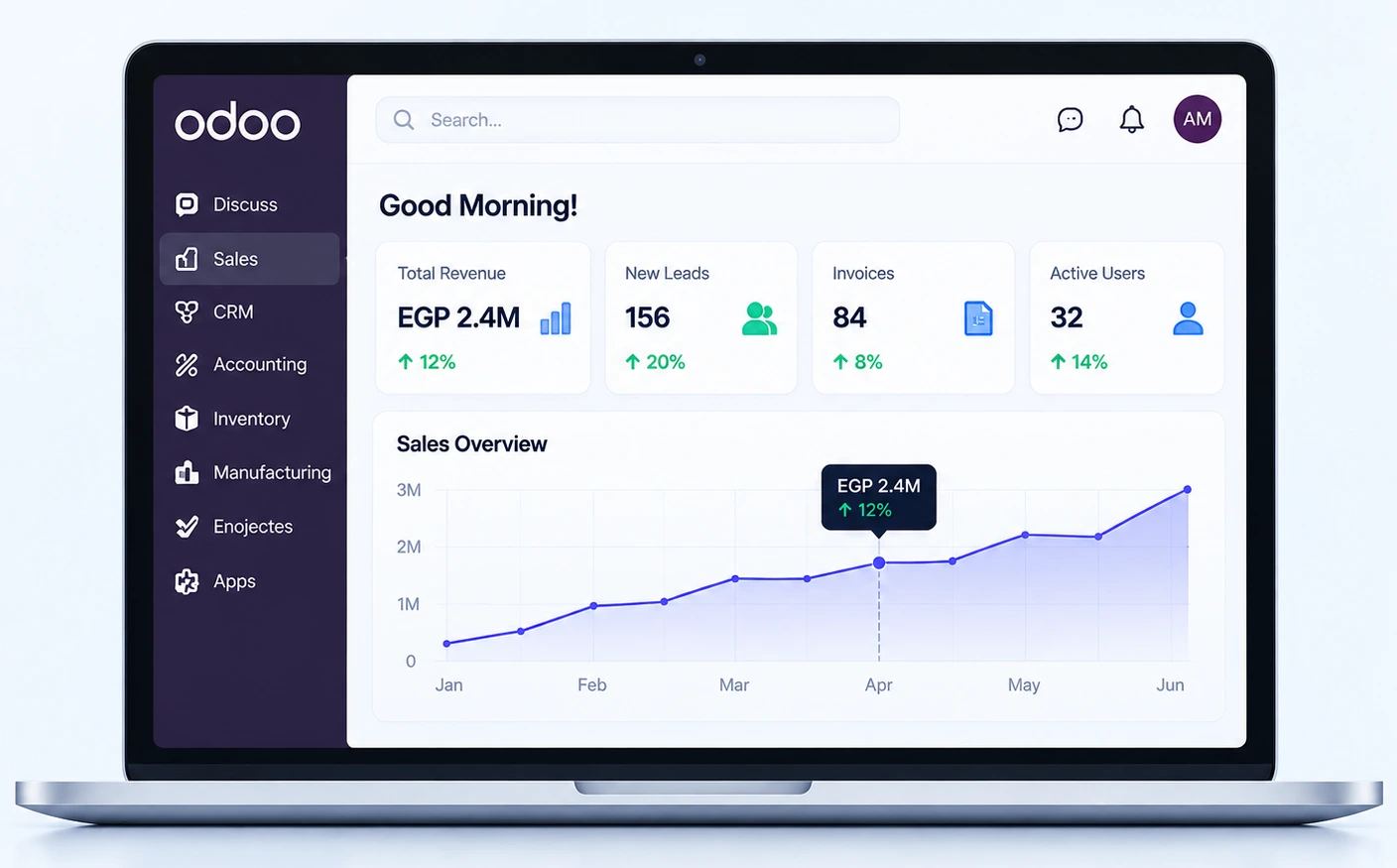
Odoo vs Zoho vs QuickBooks: The Real Difference
QuickBooks is accounting-first software, built to get bookkeeping running quickly with a familiar, straightforward setup. Most small businesses that start with QuickBooks do so because their immediate problem is accounting, not operations more broadly.
Zoho Books is also accounting-focused, but sits inside a wider Zoho app ecosystem that can extend into CRM, inventory, and other tools as a business grows — though each addition is still a separate app connecting to the others, rather than one unified system.
Odoo is a different category entirely. It’s a full ERP platform where accounting is one module among many — CRM, inventory, HR, and manufacturing all live in the same database by design, not bolted on later through integrations. This structural difference is what actually drives most of the decision between them, more than any single feature comparison.
Pricing: What These Platforms Actually Cost
Plan prices, included features, regional terms and user limits can change. Check each vendor's current offer for your market, then compare the licensing and support requirements for the same project scope.
Comparing sticker prices alone misses the point, though. The real cost difference shows up once a business needs more than one of these systems talking to each other — separate accounting, inventory, and CRM tools each carry their own subscription, and someone still has to keep the data between them in sync.
Figures are indicative estimates and vary by scope. Vendor list prices change, so check current pricing before budgeting.
The Question Global Comparisons Miss: E-Invoicing Compliance
This is where most Odoo vs Zoho vs QuickBooks comparisons fall short for this region, because they’re written for a US audience.
Tax and e-invoicing support varies by product, edition, version and implementation. Ask each vendor or implementation partner to demonstrate the required workflow for your market, and confirm who is responsible for configuration and regulatory review before choosing a platform.
User Limits and Scalability
User limits, available modules, and the way products connect to other applications depend on the selected plan and current product terms. Compare the applications, user roles, integration needs and subscription costs for your expected operating scope.
When QuickBooks or Zoho Is Actually the Right Choice
This deserves an honest answer, not a sales pitch. A business with straightforward accounting needs and no requirement to connect broader operational workflows may find QuickBooks or Zoho Books suitable. Compare the features, support and current pricing against what the team needs today.
If your business fits that description today, switching to a full ERP platform before you need one adds complexity without adding value.
When to Choose Odoo Instead
Odoo becomes the stronger choice once a business operates across more than one of these three markets, needs more than accounting alone — inventory, HR, CRM, or manufacturing — or must handle e-invoicing compliance in Egypt, Saudi Arabia, or the UAE natively rather than through a workaround.
Implementation timing depends on the modules, data, integrations, customization and user readiness. Our guide on Odoo implementation planning explains the factors to review.
Conclusion
Odoo vs Zoho vs QuickBooks isn’t really a question of which platform is “best” in general — it’s a question of which one matches where your business actually is today, and where it’s headed. For a small, single-country operation with simple accounting needs, Zoho or QuickBooks may be the right call. For a business operating across Egypt, Saudi Arabia, or the UAE that needs e-invoicing compliance and more than accounting alone, Odoo is built for exactly that scope.
Frequently asked questions
Is Odoo more expensive than Zoho or QuickBooks?
Compare current licensing, implementation, integrations, training and support for your requirements. Pricing and included features vary by plan and region.
Do Zoho Books or QuickBooks support e-invoicing in Egypt, Saudi Arabia, or the UAE?
Support depends on the product, edition, configuration and current local requirements. Ask each vendor to demonstrate the required e-invoicing workflow and explain implementation responsibilities.
Is Odoo overkill for a small business?
It can be. A small, single-country business with simple accounting needs and no plans to add inventory or HR is often better served by QuickBooks or Zoho Books, at least initially.
Can you migrate from QuickBooks or Zoho to Odoo later?
Yes, migration is possible in either direction, though it involves real setup work rather than a simple import. Planning the move before data grows too large makes the process considerably smoother.
What’s a reason to consider switching from Zoho or QuickBooks to Odoo?
A business may consider an ERP when it needs finance connected with workflows such as inventory, CRM, HR or manufacturing. Compare migration effort and the actual integration requirements before deciding.