
Odoo Hosting in Egypt, Saudi Arabia & the UAE: Online vs Odoo.sh vs On-Premise
Choosing Odoo is one decision. Where to run it is another — and it's the one businesses in Egypt, Saudi Arabia, and the UAE most often make without understanding the trade-offs. The hosting you pick shapes how much you can customize, how you handle local compliance, who maintains the system, and how much control you keep.
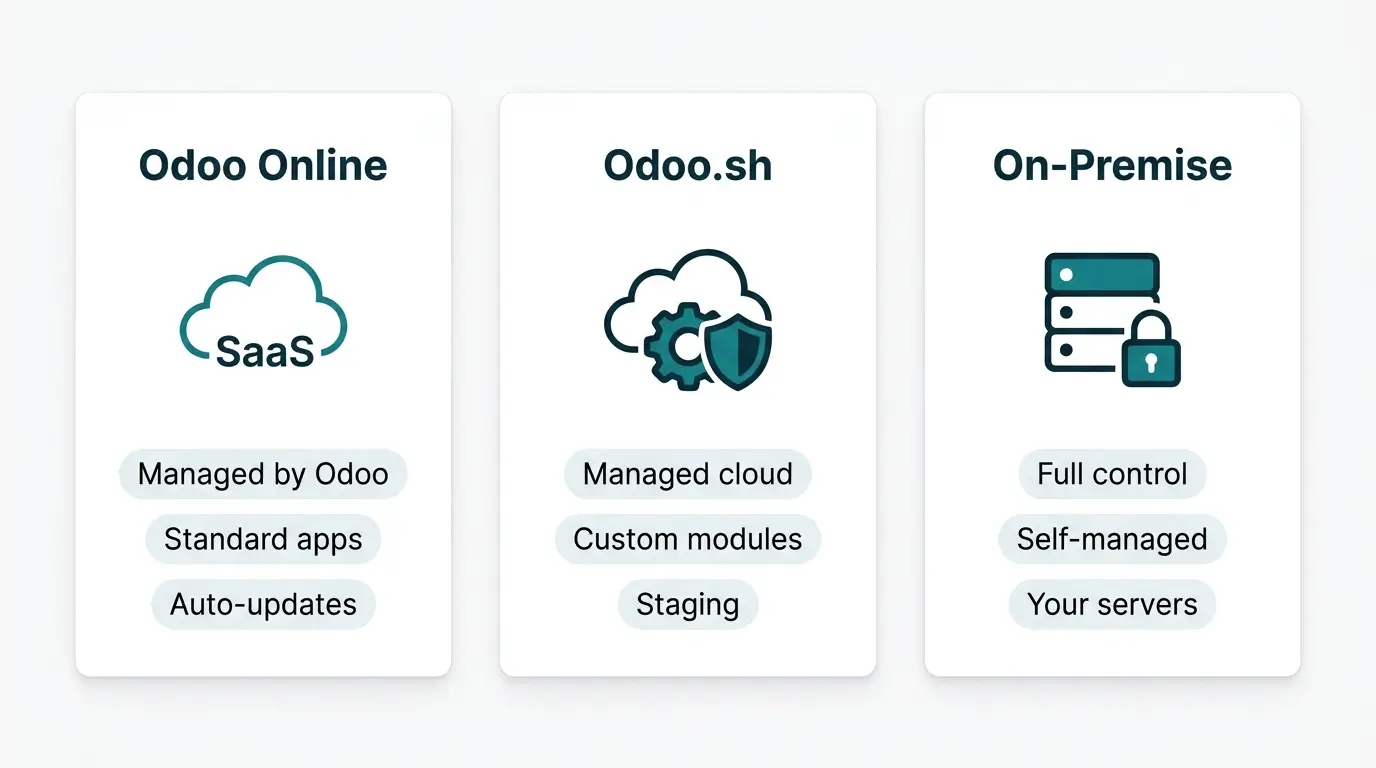
Odoo runs in three ways: Odoo Online, Odoo.sh, and on-premise (self-hosted). This guide explains what each one actually is, where it fits, and the one factor most comparisons skip — how your hosting choice affects customization and local compliance.
The Three Ways to Run Odoo
Each option is a different balance of simplicity, flexibility, and control:
- Odoo Online (SaaS) — Odoo hosts it for you. You get standard Odoo apps with automatic updates and nothing to maintain, but you can't install custom code or third-party modules. It's the simplest way to start.
- Odoo.sh — Odoo's managed cloud platform. Odoo runs the infrastructure, but you can install custom modules and third-party apps, and you get staging and development environments for testing. It's the middle ground: managed, but flexible.
- On-premise (self-hosted) — you run Odoo on your own server or cloud. You get full control and can customize anything, but you're responsible for hosting, updates, backups, and security yourself.
The right choice isn't the most powerful one — it's the one that matches how much you need to customize and how much you want to manage.
Odoo Online vs Odoo.sh vs On-Premise: Side by Side
The practical differences come down to a few factors:
| Odoo Online | Odoo.sh | On-Premise | |
|---|---|---|---|
| Hosting & maintenance | Odoo manages it | Odoo manages it | You manage it |
| Custom code / modules | Not supported | Supported | Supported |
| Updates | Automatic | You choose when | You do them |
| Control | Least | Medium | Full |
| Best for | Standard needs, fast start | Custom needs, managed cloud | Full control / data in-house |
The table tells you the what. The factor that decides most real cases is the one these comparisons usually rush past.
The Factor Most Comparisons Miss: Customization & Local Compliance
For a business in Egypt, Saudi Arabia, or the UAE, one hosting question matters more than the rest: how much will you need to customize?
Odoo includes standard localizations — including e-invoicing for Egypt's ETA and Saudi Arabia's ZATCA — and those work across hosting options. The difference shows up the moment you need something beyond standard: a custom integration, a tailored approval flow, or a third-party module for a local system. Odoo Online doesn't allow custom modules at all — so if your setup needs them, Online rules itself out, and the choice narrows to Odoo.sh or on-premise.
That's the trap: a business picks Online because it's the simplest, then hits a wall when a local requirement needs a module it can't install. Knowing your customization needs before you choose avoids an expensive migration later.
Data location matters too: if your data must stay on your own servers for a regulator or a client, on-premise gives you that control, while Online and Odoo.sh are hosted by Odoo. For most businesses the bigger question is still customization — but it's worth deciding both before you commit.
Which Option Fits Your Business
The right fit depends on your needs, not the feature list:
- Standard processes, want to start fast — Odoo Online. Simplest, nothing to maintain, ideal if standard Odoo covers how you work.
- Need customization without the maintenance — Odoo.sh. Custom modules on a managed cloud suits most growing businesses with specific local needs.
- Need full control or data in-house — on-premise. Best if you have the IT capacity and strict control or data-location requirements.
- Not sure which you'll need — scope your customization and compliance needs first, because they decide the shortlist.
Cost varies with your number of users, the apps you run, and your setup, so the figure that matters is the one for your business — book a free consultation to get pricing matched to your size and workload. It also helps to see hosting as part of the wider Odoo implementation decision, not a separate one.
Frequently asked questions
What's the difference between Odoo Online and Odoo.sh?
Odoo Online is a fully managed SaaS where you use standard Odoo apps but can't install custom code. Odoo.sh is Odoo's managed cloud platform that does allow custom modules, plus staging and development environments — so it suits businesses that need customization without managing their own servers.
Can I use custom modules on Odoo Online?
No. Odoo Online supports standard Odoo apps only. If you need custom modules or third-party apps, you need Odoo.sh or an on-premise setup.
Does Odoo support e-invoicing for Egypt (ETA) and Saudi Arabia (ZATCA)?
Yes — Odoo includes standard localizations for ETA and ZATCA, and they work across hosting options. Only if your compliance needs go beyond the standard localization would you need custom modules, which Odoo Online doesn't allow.
Is on-premise better than cloud hosting for Odoo?
Neither is better — they're different. On-premise gives full control and lets you keep data on your own servers, but you're responsible for hosting, updates, backups, and security. Cloud options (Online or Odoo.sh) remove that maintenance burden.
Can I move between Odoo hosting options later?
Yes, migrating between Online, Odoo.sh, and on-premise is possible, but it takes planning — especially if you've customized. Choosing the right option up front saves a migration later.
How much does Odoo hosting cost?
It depends on your number of users, the apps you run, and your setup. The most accurate figure for your business comes from talking to an Odoo partner — book a free consultation for pricing matched to your size and workload.
There's no single best way to host Odoo — only the one that fits how much you need to customize, how you handle local compliance, and how much you want to manage. Online keeps it simple, Odoo.sh adds flexibility without the maintenance, and on-premise gives full control. For businesses across Egypt, Saudi Arabia, and the UAE, decide based on your customization and compliance needs first — and, if it helps, work with a local partner who can run or migrate any of the three.